











- Calculation
- Capillary action (capillary effect)
- Capillary pore / Capillary
- Capillary water absorption
- Carbonation
- Catalyst
- Cavity / Air entrapment in concrete (unwanted)
- CE Marking / CE Declaration of Conformity
- Celsius (°C)
- CEM
- Cement
- Cement injection
- Cement paste
- Cement stone
- Cement suspension
- Certificate of conformity
- Chemically bound water
- Civil engineering / Civil engineering structure / Structural engineering
- CM Method (calcium carbide measuring method)
- Cohesion / Cohesive force
- Cohesive failure
- Cohesive soil
- Compaction of concrete
- Compaction pore
- Component
- Compression (longitudinal)
- Compressive strength - hardened concrete
- Compressor
- Compulsory mixer
- Concrete
- Concrete corrosion
- Concrete cover
- Concrete pocket (rock pocket)
- Concrete reinforcement detector (concrete cover meter)
- Concrete replacement
- Concrete spalling
- Condenser dryer (construction)
- Connection by adherence
- Construction joint
- Construction Products List (Bauregelliste BRL)
- Coring
- Corrosion (metals)
- Corrosion of reinforcement
- Crack
- Crack cause
- Crack depth
- Crack direction
- Crack edge
- Crack flank
- Crack injection
- Crack magnifier
- Crack mapping
- Crack movement monitor
- Crack type
- Crack width
- Crack width changes
- Crack width ruler
- Curtain injection
Cement paste
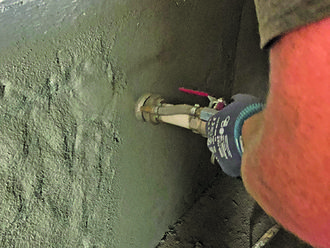
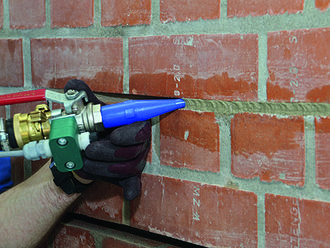
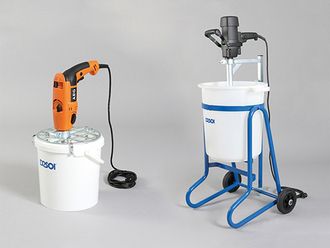
Cement paste is a mix of water and cement. The exact mixing ratio is defined by the water-cement ratio (ratio). paste resp. stone (hardened cement paste) is required as binder when producing concrete, mortar, and screed. In the field of concrete repair, pure cement paste is used for filling cracks (from about 0.8 mm width of crack) and cavities (cement injection).